
Introduction
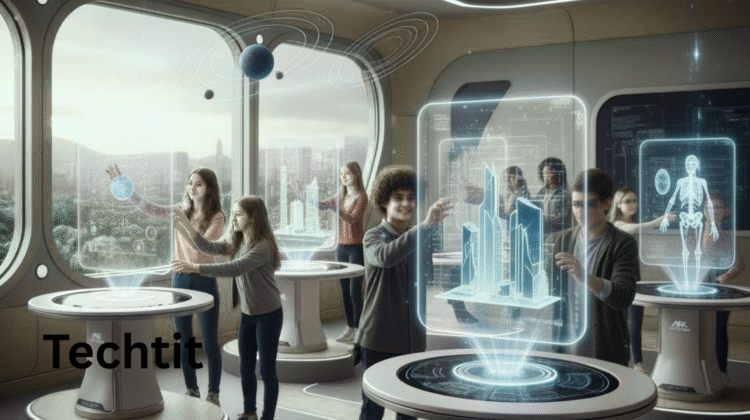
Imagine standing before a screen where the digital world blends with your own. You reach out, and a virtual object reacts to your movement as if it were real. This is no longer a dream from a sci-fi movie. It’s the living, breathing innovation called Ark Augmented Reality.
Developed by the Computer Graphics Centre in Portugal, the ARK system (Augmented Reality Kiosk) reshapes how we think about augmented experiences. It does not need expensive headsets or advanced hardware. Instead, it uses innovative engineering to deliver deep immersion through a standard 21-inch monitor. The project reflects years of research into how humans perceive and interact with virtual elements in real space.
Ark Augmented Reality shows that immersive experiences do not require futuristic gear. It opens the door to a future where anyone can explore digital worlds naturally, at a fraction of the cost.
The Concept Behind Ark Augmented Reality
Ark Augmented Reality was designed to make mixed-reality experiences accessible to everyone. Traditional AR relies on head-mounted displays or specialized glasses, which can be costly, heavy, and complicated for long periods.
The ARK system changes that equation. It uses an interactive kiosk setup where a camera and monitor work together to place virtual objects within a real environment. The user can move their hands or body to interact with 3D visuals as if they were physically present. This new form of interaction creates a bridge between what we see and what we feel.
According to the Computer Graphics Centre, the project aims to eliminate the barriers that stop people from enjoying augmented environments. By focusing on simplicity and practicality, the team built a system that feels intuitive even for beginners.
Solving the Occlusion Challenge
One of the most significant technical issues in AR is occlusion. This happens when digital objects appear either over or under real ones in ways that break realism. The Ark Augmented Reality team tackled this problem with an elegant solution.
They used a combination of real-time tracking and 3D depth sensing to make sure virtual elements behave correctly in the physical world. If you move your hand in front of a virtual object, the system detects it instantly and hides part of the digital image behind your hand. This small detail makes the experience feel real.
This solution allows Ark Augmented Reality to create a sense of depth and connection that headsets often struggle to achieve. It feels less like looking through a lens and more like interacting within your own space.
Design Simplicity and Accessibility
The magic of Ark Augmented Reality lies in its simplicity. The hardware comprises a regular monitor, a camera, and innovative tracking software. There is no need for expensive motion sensors or high-end computers.
This setup makes the ARK system a flexible platform that can fit in classrooms, museums, malls, and offices. It allows users of all ages to enjoy augmented reality without technical barriers.
Because the ARK system is cost-effective, it also supports large-scale deployment. Imagine museums offering digital exhibitions where visitors interact with ancient artifacts recreated in 3D. Students could explore planets or molecules without wearing special equipment.
Ark Augmented Reality makes all that possible with technology that is both approachable and scalable.
A Step Beyond Traditional AR
Many people associate AR with smartphone apps like Pokémon GO or social media filters. Those are examples of overlay AR — adding images to a live camera view. But Ark Augmented Reality goes further.
It creates an interactive AR environment that feels stable and natural. The virtual elements are not just floating visuals; they react to lighting, perspective, and movement. The system tracks the user’s position to update the scene in real time.
This makes Ark Augmented Reality suitable for scientific demonstrations, digital art, and immersive education. Unlike consumer AR tools, it delivers a deeper level of realism that helps users understand concepts through direct experience.
Human-Centered Interaction
The ARK system was built around how people naturally move and perceive objects. Its design allows users to interact without controllers or wearables. Every motion, gesture, or angle creates a response.
This natural form of engagement keeps users active and curious. In education, students stay focused because they are not just watching—they are doing. Visitors can explore digital forms in art installations as if walking through an unseen gallery.
Ark’s augmented reality human-centered design sets it apart. It removes the friction between user and machine, creating a pure, personal experience.
Applications in Education
Education is one of the most promising areas for Ark Augmented Reality. Imagine a history class where students stand before a screen and explore a 3D reconstruction of a Roman city. They can zoom in on structures, read about them, and view animations showing how people once lived.
Science teachers could use the system to demonstrate chemical reactions or biological processes. Geography lessons could come alive with rotating planets and mountain ranges that respond to touch.
Since the ARK system does not require wearable devices, it fits perfectly in classroom settings. It allows group participation and encourages collaborative learning. Students learn faster when lessons involve both vision and movement.
Role in Museums and Cultural Exhibits
Museums worldwide are searching for ways to modernize visitor engagement. Ark Augmented Reality offers a practical path forward. It allows institutions to merge digital storytelling with authentic artifacts.
For instance, a visitor looking at a fossil could use the kiosk to visualize how the creature looked in motion. Historical sites could bring ancient ruins to life through digital reconstruction.
Portugal’s Computer Graphics Centre has already showcased prototypes at tech fairs and museum exhibits. The results show strong public interest and high engagement levels. People remember what they can interact with. That’s the real power of Ark Augmented Reality.
Impact on Retail and Marketing
Retail spaces can also benefit from this technology. Ark Augmented Reality could let customers view products in different colors, styles, or configurations on a kiosk. They could explore how furniture fits in their space or how clothing appears in motion.
This kind of interaction increases buyer confidence and reduces returns. Brands gain a creative edge by providing experiences instead of static displays. Marketing campaigns could use Ark AR installations to attract attention and create memorable impressions.
The approach fits modern consumers who value visual storytelling and interactivity over traditional ads.
Healthcare and Simulation
The medical field stands to gain from the depth and clarity of Ark Augmented Reality. In training, students could practice surgical procedures virtually before operating on real patients. The ARK system’s precision tracking makes such simulations accurate and safe.
Doctors could also use AR-based kiosks to explain procedures to patients, showing how treatments work inside the body. This visual aid reduces anxiety and improves understanding.
Hospitals could adopt similar systems for physical therapy exercises or cognitive rehabilitation programs. By engaging patients with interactive visuals, therapy becomes more effective and less intimidating.
The Future of Work and Design
Ark Augmented Reality can benefit architecture, engineering, and product design professionals. Designers could test models in 3D before final production, and clients could see and manipulate projects in real space without the need for complex setups.
This approach saves time and cost while improving creativity. Instead of imagining how something might look, teams can interact with it directly. The ARK system provides immediate visual feedback that helps refine ideas faster.
In collaborative environments, multiple people can share the same AR experience, making teamwork smoother and more effective.
Comparison with Head-Mounted Displays
Devices like Microsoft HoloLens and Apple Vision Pro push the limits of AR hardware, but they come with high prices and complex interfaces. Ark Augmented Reality offers a more straightforward path to similar goals.
Users avoid fatigue and discomfort because it relies on an external screen rather than wearable tech. It is also more hygienic in public spaces and easier to maintain.
While headset-based AR may remain popular among professionals, Ark AR’s kiosk model makes it ideal for education, retail, and public installations. It brings immersion to places where accessibility matters most.
Technical Foundation
Ark Augmented Reality operates on several core technologies. It synchronizes digital objects with real-world physics using real-time computer vision, depth mapping, and motion detection.
Its software, developed at the Computer Graphics Centre, ensures smooth tracking and realistic lighting. The system can recognize surfaces, detect motion, and adjust the scene accordingly.
Using affordable components like standard cameras and monitors keeps costs low without reducing quality. This makes the ARK system an efficient tool for both developers and institutions.
Global Research and Support
The Ark project aligns with international research in mixed reality and computer graphics. Institutions like MIT Media Lab and the University College London’s Immersive Lab have conducted similar studies.
These collaborations highlight a global shift toward accessible, human-centered AR. Systems like ARK make immersive tech more democratic by removing the need for heavy hardware. Anyone can experience advanced AR without high barriers.
The Computer Graphics Centre continues to refine its prototype, aiming for greater realism and user flexibility. Future updates may include gesture recognition improvements and wider display integration.
Social and Cultural Impact
Technology influences how people connect, learn, and create. Ark Augmented Reality has the potential to make digital experiences part of daily life without isolation.
Unlike VR, which shuts users inside a headset, Ark AR keeps them present in their environment. It promotes shared experiences. Families can explore educational exhibits together, and teams can collaborate on projects while seeing the same visuals.
This shared interaction creates a social layer missing in many immersive systems. It turns technology into a bridge rather than a wall.
Challenges and Future Development
Every technology faces hurdles before mass adoption. For Ark Augmented Reality, the main challenges are scalability, maintenance, and content creation. Developers must design engaging experiences that keep users returning.
Hardware calibration also requires precision, though new sensors are improving accuracy. Future models might include modular screens or portable versions for classrooms and events.
The creators are already working on integrating cloud support and better AI-driven scene understanding. These updates will make the ARK system smarter and easier to deploy globally.
The Road Ahead
The future of Ark Augmented Reality looks bright. It combines simplicity, affordability, and innovation in a single platform. As immersive technologies continue to grow, systems like ARK prove that meaningful interaction does not need to be expensive or complex.
This technology opens possibilities for storytelling, education, art, and business. It reflects a shift toward experiences that feel human, accessible, and shared.
Ark Augmented Reality invites everyone to enter a world where imagination meets reality. It’s not about escaping life but enhancing how we see it.
Read More: Hosted Event Zero1Vent: Shaping the Future of Technology

Leave a Reply